
Pumps & Compressors: Noise Reduction and Vibration Isolation Strategies for HVAC Contractor Installation
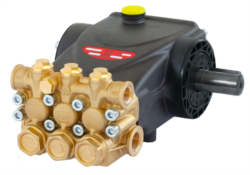
Table of Contentsexpand_more
Understanding Pump and Compressor Noise Sources in HVAC Systems
Pumps & Compressors generate noise through multiple physical mechanisms that HVAC contractors must address during system design and commissioning. Airborne noise originates from discharge pulsations, cavitation, and bearing friction, while structure-borne noise travels through pipe walls, mounting brackets, and building frames. In chiller systems and high-pressure hydronic loops typical of Southeast Asian commercial buildings, noise levels often exceed 80–85 dB at one meter without proper isolation.
The root causes vary by equipment type. Positive displacement pumps like the Interpump E2C2111 L operating at 1750 rpm generate inherent flow ripple at discharge frequencies directly proportional to displacement and rotational speed. Gear pumps such as the Interpump SSU2040 R ATEX produce meshing frequency noise as teeth engage, creating tonal disturbances contractors cannot eliminate through fluid conditioning alone. Reciprocating compressors exhibit valve slamming and suction noise, while rotary units generate discrete harmonic peaks. Understanding these sources allows contractors to apply targeted mitigation at the source rather than attempting building-level soundproofing after commissioning.
In humid tropical climates across Singapore, Malaysia, and Indonesia, vibration-driven condensation promotes corrosion in uninsulated piping and accelerates bearing wear through fretting. Noise complaints from building occupants often trigger costly remediation, making upfront isolation investment essential for schedule and reputation management.
Vibration Isolation Mounting and Decoupling Design
Effective vibration isolation begins at the equipment foot. Pumps and compressors must decouple from building structure through elastomeric or spring isolators sized to the natural frequency of the mounted system. For a typical chiller pump installation, the isolation system's natural frequency should be 25–30% of the excitation frequency to achieve >80% attenuation in the critical operating range.
For units like the Pratissoli KF30 pump rated at 40 kW and 72 kg mass, contractors must calculate the required isolation stiffness using the formula: f = (1/2π)√(k/m), where k is combined isolator stiffness and m is total mounted mass including fluid and connected equipment. A typical 4-point isolation system using elastomer pads rated 0.5–1.5 Hz isolation frequency maintains separation between 50–60 Hz motor excitation and the structural resonance zones common in commercial HVAC frames.
Spring isolators excel in high-vibration applications like the Interpump W2035 L ATEX (13.23 kW, 35 L/min), as they maintain consistent performance across temperature swings encountered in tropical installations. Elastomeric isolators require selection for fluid compatibility—synthetic rubber compounds resist mineral oil but may degrade with PAO or ester fluids common in modern HVAC systems. Contractors must specify isolator material compatibility during procurement; 3G Electric's 35+ years distributing industrial equipment includes guidance on regional humidity effects on elastomer performance.
Pipe connections demand equal attention. Flexible hoses at pump inlet and discharge prevent rigid pipe bridges from transmitting vibration into building structure. Hard-piped systems require minimum 1–2 meter separation between pump discharge and the first rigid support, allowing low-frequency vibration modes to attenuate. Contractors installing multiple units should stagger mounting locations and avoid common mounting frames that couple vibration between units.
Acoustic Enclosure and Fluid-Path Silencing Strategies
Where equipment space permits, partial or full acoustic enclosures reduce airborne noise by 10–15 dB without restricting access or cooling. Materials should absorb pulsation frequencies while allowing equipment servicing. Melamine foam at 50 mm thickness effectively attenuates the 100–500 Hz range typical of positive displacement pumps operating at standard commercial speeds. For hazardous-area installations requiring ATEX compliance, enclosures must maintain ventilation and electrical safety compliance.
Fluid-path silencing complements mechanical isolation. Pulsation dampers installed at pump discharge absorb flow ripple before it travels downstream, reducing propagation into long pipe runs. For the Interpump E2C1714 L and similar compact units, a hydro-accumulator (0.5–1 liter capacity, pre-charged to 0.6× system pressure) reduces discharge ripple by 50–70%. This approach proves cost-effective in retrofit scenarios where mounting isolation is limited by structural constraints.
Inlet filters and suction strainers must be sized conservatively to maintain inlet velocity below 0.6 m/s; cavitation noise escalates dramatically above this threshold. In systems transporting hot return fluid in tropical climates, fluid temperature rise amplifies vibration transmission. Contractors should specify coolers maintaining fluid viscosity stability, as viscosity drift alters pump internal clearances and noise signatures.
Pipe routing away from occupied spaces, with 90° elbows replaced by sweeping bends where feasible, reduces radiated noise. Insulating wrap on discharge piping (25 mm elastomeric foam) provides 5–10 dB attenuation in mid-frequency bands without impacting thermal performance in well-ventilated plant rooms.
Specification and Commissioning Practices for Noise-Controlled Systems
During procurement, HVAC contractors should request sound power level (LW, in dB) specifications from distributors rather than relying on typical installation noise (dB) figures, which omit isolation and piping effects. 3G Electric supplies datasheets for units like the Interpump E2C2111 L that include baseline acoustic data enabling contractors to calculate downstream attenuation.
System commissioning must include acoustic testing at design operating points. A Type 2 sound level meter (±4 dB accuracy) positioned 1 meter from equipment at 0° to discharge direction establishes baseline noise, compared against contract specifications. If baseline exceeds target by >3 dB, isolation effectiveness or enclosure design requires revision before final handover—addressing issues post-commissioning costs 3–5× the preventive adjustment.
Vibration velocity should be measured perpendicular to pump mounts at startup and operating speed; values exceeding 7.1 mm/s indicate inadequate isolation or internal mechanical wear. Contractors using portable vibration analyzers (ISO 20816 standards) identify bearing degradation before failure, preventing secondary noise increases that prompt tenant complaints.
For multi-unit installations common in Singapore's district cooling and large commercial HVAC systems, phased commissioning isolates acoustic signatures of individual equipment. This approach identifies whether combined vibration from parallel pumps or compressors creates resonant coupling in the building structure—a condition requiring stagger-frequency operation scheduling or mechanical decoupling.
Tropical installation considerations include seasonal fluid viscosity management and humidity-induced elastomer softening. Contractors should re-verify isolation performance after 6 months of operation in high-humidity environments; elastomer relaxation may reduce stiffness, degrading isolation effectiveness. Preventive replacement schedules align with maintenance planning to avoid unexpected noise escalation during the building's occupied season.
Integration with Building Acoustics and Long-Term Reliability
Pump and compressor noise does not exist in isolation—interaction with building resonances determines occupant perception. An 80 dB pump operating at a building structural resonance frequency (often 20–40 Hz in multi-story commercial structures) may be perceived as 85+ dB due to room amplification. Contractors coordinating with building systems engineers can identify and avoid these frequencies during system startup programming.
For ATEX-compliant applications like installations using the Interpump W2035 L ATEX in solvent extraction or laboratory HVAC systems, acoustic improvements must preserve equipment cooling and ventilation. Enclosures require blast-proof design considerations that add cost; specification of lower-displacement or lower-speed alternatives during design phase proves more cost-effective than retrofit silencing.
Long-term reliability benefits emerge from vibration control. Reduced bearing loads extend seal life by 30–40%, lower maintenance frequency, and decrease unplanned downtime in mission-critical systems. Secondary systems like heat exchangers and expansion tanks experience reduced fatigue stress, extending component life beyond standard maintenance intervals.
Contractors supporting facilities across Southeast Asia benefit from 3G Electric's 35-year experience sourcing compatible equipment for regional climatic and electrical standards. Noise-controlled specifications developed for one market region transfer to others with minimal adaptation, allowing contractors to replicate proven designs and reduce engineering cycles on repeat projects.
![Oil Pump Singapore: Complete Buyer's Guide [2026]](https://oxalncjenpflyqfncuhe.supabase.co/storage/v1/object/public/product-assets/grainger/84612678-850d-43eb-92ae-dcc86df1619a.jpg)
![Dayton Centrifugal Pump SG | Sizing Guide [2026]](https://oxalncjenpflyqfncuhe.supabase.co/storage/v1/object/public/product-assets/grainger/21a225f1-43ff-4290-a467-4a8181c4501a.jpg)


